
Primary voting suggests 4-3 partisan divide
What justices' history of voting in primary elections tells us about a Supreme Court of Virginia ruling with far-reaching political consequences

With no registration by party in Virginia, one of the best indicators of political allegiance is a voter’s history of participating in primary elections.
By that measure, a review of the primary voting history of the justices of the Supreme Court of Virginia suggests that last week’s 4-3 decision fell along partisan lines.
Three of the four justices who voted to nullify an April 21 ballot initiative that Republicans opposed have voted exclusively in GOP state-run primary contests in the last 15 years, according to voter participation data from L2, a company that maintains voter file records in all 50 states.
The fourth justice who backed the plan has not voted in primary elections, but had made political donations to GOP candidates before he became a judge, according to a campaign finance database maintained by the nonpartisan Virginia Public Access Project.
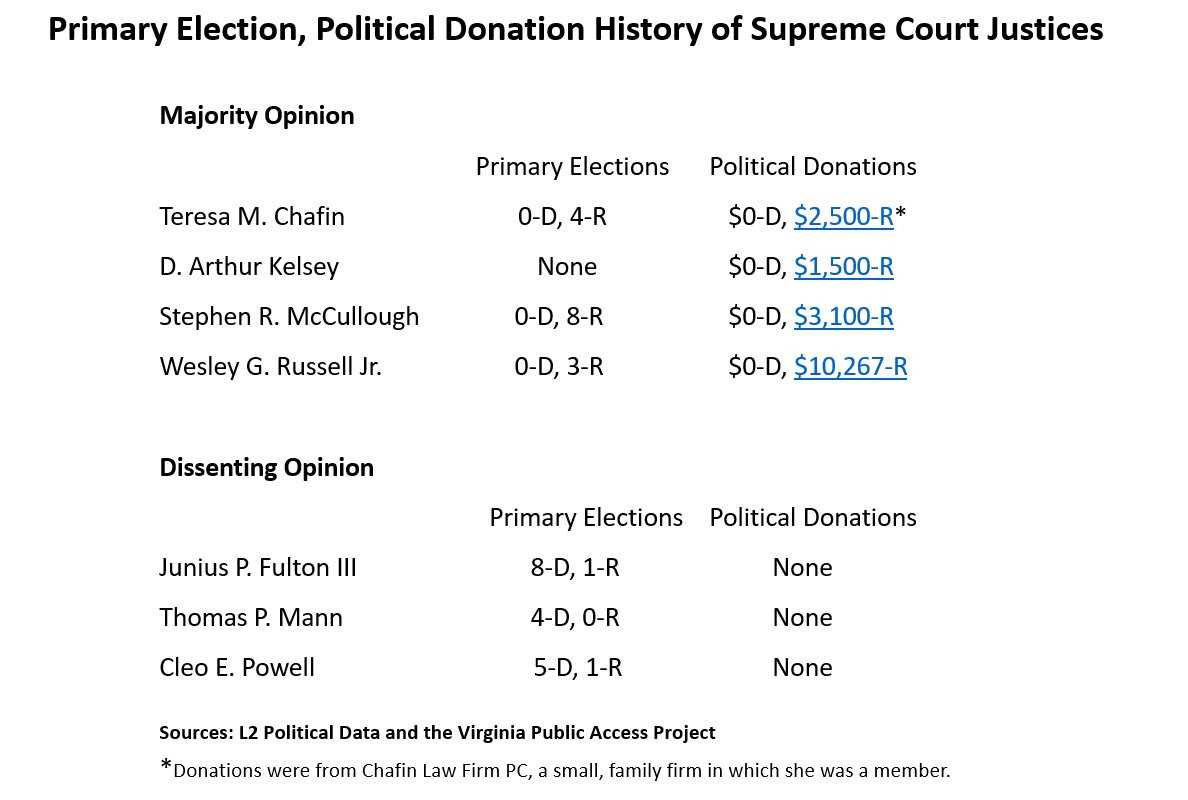
On the dissenting side, all three justices who sought to uphold an election that Democrats supported had a history of voting in Democratic primary elections. One justice participated only in Democratic primaries, while two others voted in a single GOP primary and a handful or more of Democratic contests.
The political background of the seven justices is well known to Supreme Court observers, but the court had worked hard to create a perception that it stood outside of politics.
But the explosive political stakes – in Virginia and nationally – in the court’s redistricting decision have brought closer scrutiny of justices and their backgrounds.
Robert Holsworth, a longtime political commentator, said he was not surprised about the findings of the voting history in primary elections.
“Everyone looks at the law in a way they think is politically neutral,” Holsworth said, “but it’s very difficult to disentangle … judicial and political judgment completely.”
Holsworth said the redistricting case could forever change the way the public perceives the Supreme Court of Virginia.
“The court’s going to look more like states that elect judges,” he said. “If one party has control, there’s not going to be any doubt where the judges stand.”
The politics of the 4-3 decision should be on full display next winter when the Democrat-controlled General Assembly decides whether or not to reappoint D. Arthur Kelsey, the justice who penned the majority opinion.
Democrats sought a way to enlist Virginia to push back against President Donald Trump’s unprecedented mid-decade effort to redraw congressional maps in Republicans’ favor in time for midterm elections this November.
But Democrats first needed to amend the state constitution to bypass a bipartisan redistricting commission voters approved in 2020. The process normally takes two years, but Democrats had only six months to get it done.
Voters narrowly approved a constitutional amendment on April 21, clearing the way for Democrats to impose a partisan gerrymander intended to eliminate four of five GOP congressional seats.
Last week, the Supreme Court of Virginia ruled that in their rush, Democrats cut legal corners that invalidated the election and nullified the vote.
Though Virginia legislators - not voters - elect the state’s judges, politics always has played a role in judicial appointments. In 2021, for instance, when the General Assembly voted to expand the Court of Appeals by eight justices, the Democrats who controlled the House of Delegates refused to consider any Republican-nominated candidates.
Judicial ethics require justices of the Supreme Court of Virginia to steer clear of partisan political activity in order to maintain public trust in the courts’ independence and impartiality.
One exception to the state Canons of Judicial Conduct allows judges to participate in primary elections organized by the state Department of Elections. Judges are allowed to vote in primaries because state-run elections do not require a “pledge to support” one political party.
“The act of a judge voting in a primary election is the discharge of an honorable civic duty and an obligation of responsible citizenship,” according to the Canons of Judicial Conduct.
Records show that all but one of the seven justices have voted in primary elections in the last 16 years.
Campaign donations are another indication of the partisan divide in the 4-3 decision. Judges are forbidden from making political contributions, but the VPAP data shows that all four justices in the majority had a history before their judicial careers began of making political donations to GOP candidates.
All of the donations were personal, except for Teresa M. Chafin, who was part of a small, family owned law firm in Lebanon that made $2,500 in political donations to GOP candidates between 2001 and 2004, before she became a circuit court judge.
None of the three dissenting justices have been political donors since 1997, according to VPAP.