
Spanberger as Editor-in-Chief
The governor and her chief of staff played an unprecedented hands-on role in marking up legislation this spring, riling fellow Democrats with a record number of rewrites and vetoes.

RICHMOND – When the General Assembly left town in March, a stack of 1,100 approved bills eventually made its way to the governor’s office for action -- approve, propose an amendment or veto.
Gov. Abigail Spanberger and her chief of staff rolled up their sleeves, determined to read as many of them as possible.At a joint appearance in March, Spanberger and Bonnie Krenz-Schnurman sounded like two type-A students competing as they powered through the night.
Krenz-Schnurman said she would come home in the evenings and read bills while breastfeeding her infant daughter.
“I go home every night with a big stack of bills to look at,” Krenz-Schnurman said. “When she goes to sleep and sometimes also while she’s eating, I have my whole little setup on my bed.”

Spanberger recalled her husband giving her a hard time for hogging his side of the bed in the Executive Mansion.
“I had just stacks of bills in different piles … they were solidly on his side of the bed,’” she said with a chuckle.
The political fallout from the Spanberger administration’s heavy-handed edits and vetoes of bills sponsored by fellow Democrats this spring has been widely reported. But this is the first account of an unprecedented hands-on role that the governor and her chief of staff played in the bill-review process.
Spanberger and Krenz-Schnurman detailed their bill-review marathon at a “Women Who Matter” event on March 26. Both described their extra effort as part of their determination to change public expectations about how women political leaders can balance motherhood and high-level roles.
“I do think it’s really extraordinarily important to set examples of the things that are possible and not easy – but absolutely possible,“ Spanberger said.
Krenz-Schnurman said one key to success is “intentionality” in making the most efficient use of her time.
But longtime political observers say they were surprised to learn that Spanberger and Krenz-Schnurman devoted so much time and effort to reviewing legislation, a chore that a governor traditionally delegates to the policy staff.
The combination of both a governor and her chief of staff devoting so many hours poring over legislation has no precedent in modern Virginia political history, according to interviews with more than a half dozen officials who have served in past administrations.
In her first legislative session, Spanberger proved to be the most heavy-handed governor in the first quarter of the 21st century, according to data compiled by the nonpartisan Virginia Public Access Project. The Democrat amended 180 bills, the most of any governor in a single legislative session this century, and vetoed 31, the most by a governor during a session when her own party controlled both chambers of the General Assembly.
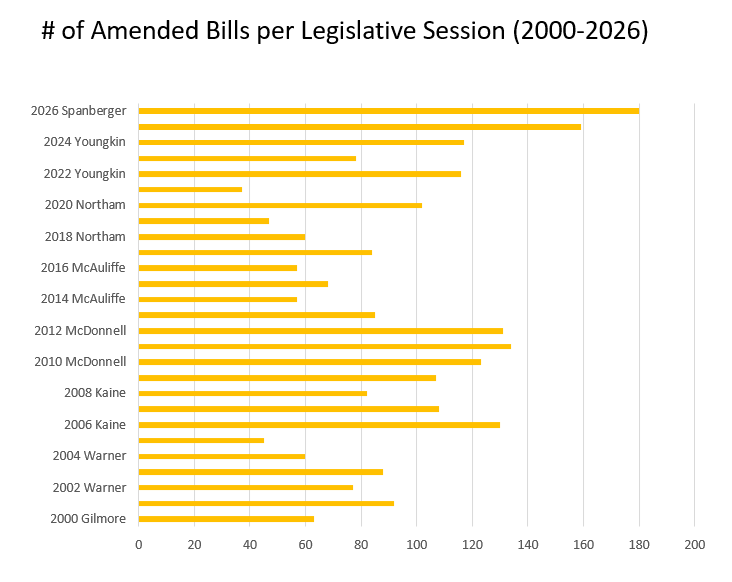
A Spanberger spokesman declined to estimate how many edits were due to issues the governor and her chief of staff flagged personally.
The flurry of amendments and vetoes dismayed fellow Democrats, creating a rift in a “trifecta” that Democrats had said would showcase how much a unified party could accomplish once it controlled the Executive Mansion and both chambers of the state legislature.
There was an expectation among Democratic legislators that dozens of progressive measures that Republican Gov. Glenn Youngkin had vetoed for two consecutive years – including paid sick leave for most employees, an increase in the minimum wage and collective bargaining for public employees – would sail through and become law this year under a Democratic governor.
Spanberger signed much of the legislation, but rewrote and vetoed some of the most high-profile measures like guaranteeing labor unions a foothold in every locality.
Her actions energized an ongoing debate over whether Spanberger is as moderate as her reputation in Congress. But she left no doubt that, procedurally, she is a precise, cautious leader.
“Every governor comes in and brings their own style,” said Bill Leighty, who served as chief of staff for Govs. Mark Warner and Tim Kaine.
Leighty said that Spanberger’s decision to spend long hours line editing bills is consistent with the style she brings from her career as a CIA case officer and a three-term member of Congress.
“She is very methodical and detail-oriented,“ he said.
In interviews with more than a half dozen people who were involved at a high level in the bill review process during past administrations, no one faulted Spanberger for paying close attention to the wording of bills, which can come together in a pell-mell way during an intense two-month legislative session.
But some questioned whether she and her chief of staff made best use of their time.
“That’s why you have a policy shop with lawyers,” said Bob Holsworth, a longtime observer of Virginia politics.
Like any new governor, Spanberger was playing catchup from the moment in mid-January when she raised her right hand on the South Portico of the state Capitol and was sworn into office. The General Assembly had a week’s head start, and the legislative process was gaining momentum.
The pace is like nothing the four-member core of her leadership team, all of whom followed Spanberger to Richmond, had experienced in Washington. The Virginia General Assembly can pass more legislation in a day than Congress adopts in a year.
It didn’t help that the governor’s suite of offices on the third floor of the Patrick Henry Building was undergoing renovation. As they tried to come up to speed, members of Spanberger’s team were scattered across three buildings on Capitol Square.
Spanberger also faced a major distraction not of her making. Democratic legislators in the House and Senate were fighting over which congressional district map to use in a proposed political gerrymander that would go before voters on April 21.
To be successful, governors must strike a delicate balance with legislators. Those who get deeply involved in legislation can be accused of meddling. Those who keep their distance can be accused of being too detached.
The governor’s role is much more clear after the legislature adjourns. She must elect whether to sign into law, amend or veto each bill.
The 2026 legislature approved more than 1,110 bills. Once they reached the governor’s office, she had 30 days to act. That resulted in a sprint to process about 40 bills every day.
Spanberger’s press office provided a description of the bill review process, which on paper looks very much like what past administrations used.
In practice, however, the process was very different.
A few governors have been more hands on. George Allen (1994-1998) was known for doodling in the margins of bills. Bob McDonnell (2010-2014) couldn’t break the line editing habit picked up during his years in the House of Delegates.
But most chief executives would not dive into the fine details of a bill unless staff flagged it as complicated, flawed, contentious or politically fraught.
Spanberger apparently decided she wanted to read the bills herself.
In her “Women Who Matter” appearance during the bill review, the governor got a laugh by telling the audience how she had begun to carry a large bag containing her daily allotment of bills everywhere she went. In fact, when she got into the car that morning for the three-mile drive to the Virginia Museum of History and Culture, a member of her executive protection unit asked if he had overlooked an overnight trip on the schedule.

“Just checking -- we’re not going anywhere today, right?” Spanberger said, quoting the officer.
Spanberger’s press office declined to make Spanberger or Krenz-Schnurman available to discuss their role in the bill review process. The press office also declined to answer questions submitted in writing.
The press office did release this statement: “The Governor closely reviewed legislation to make sure it was in the best interest of Virginians and that her Administration could successfully implement every new law. Throughout this process, Governor Spanberger relied on her experience as a legislator, listened to technical expertise from Secretariats and other subject matter experts, and reached out directly to leaders of other states that may have implemented similar legislation.“
Some question whether line-editing bills was the best use of time, particularly for Krenz-Schnurman, the chief of staff.
As the chief of staff of Spanberger’s congressional office, Krenz-Schnurman ran a staff of about 20. In Richmond, she oversees a state government workforce of 160,000.
Krenz-Schnurman is the state’s chief operating officer who manages the administration’s daily operations, oversees the Cabinet and ensures agencies are operating efficiently and effectively.
In the past, most chiefs of staff were far less engaged in reading bills during the legislative process, which was only a tiny sliver of their portfolio.
Spanberger and Krenz-Schnurman appear to still be making the transition from Washington to Richmond and from legislative to executive branch, according to one executive branch veteran who voted for Spanberger and wished her only well, but requested anonymity in order to talk frankly.
“They may have been right about a bunch of stuff, but I think it shows a fundamental misunderstanding of how to work the process,” the former official said.
The former official said some past administrations have tried to keep amendments to a minimum, even if that meant overlooking some legislation that was poorly constructed. This restraint provided the administration time to contact legislators to explain the changes, which can head off executive-legislative tensions that are inherent in the process, the former official said.
Spanberger’s maximalist approach to amendments and vetoes left her staff with little time to manage so many relationships. Her amendments touched 74 chief patrons – representing more than half of General Assembly members. Some Democratic legislators said they learned of the governor’s actions only after they had been posted on the state’s legislative website.
Some Democrats were annoyed that Spanberger and her legislative team had not raised any issues about their proposals while they were advancing through the process. Why didn’t they let them know sooner?
Sen. Scott Surovell, D-Fairfax, the Democratic floor leader, said it was important to have everyone “involved in the legislative process at all stages so their feedback can be taken into account as legislation is crafted.”
The statement from the Spanberger press office downplayed tensions among Democrats, instead contrasting Richmond with the “chaos” stirred up by President Donald Trump.
“With the tremendous chaos and uncertainty coming out of Washington, Virginians can trust their state leaders are carefully considering the impacts of new laws on families, businesses, and communities,” the statement said. “The Governor looks forward to continuing to partner with the General Assembly to find common ground, advance practical solutions, and strengthen the Commonwealth into the future.”